
Dating Safely
Dating profile red flags to avoid are often visible before you ever send a first message. A photo that looks borrowed, a bio that says almost nothing, a prompt that attacks every ex, or a lifestyle that does not match the job listed, these are clues sitting right on the screen. Learning to read them calmly can save you weeks of confusing chats, wasted hope, and in the worst cases, real money and heartbreak.
Quick Answer
Dating profile red flags to avoid include: only one photo or photos that look like a magazine shoot with no everyday pictures; an almost empty bio with no real details; bitter, demanding or hostile prompt answers; claims of wealth or a glamorous lifestyle that do not fit the stated job; details that change between the profile and the chat; pressure to move off the app immediately; and any refusal to video-call or meet in a public place. One small oddity on its own is rarely proof of anything. A pattern of two or three of these signs is your cue to slow down, verify, and walk away politely if the answers do not add up.
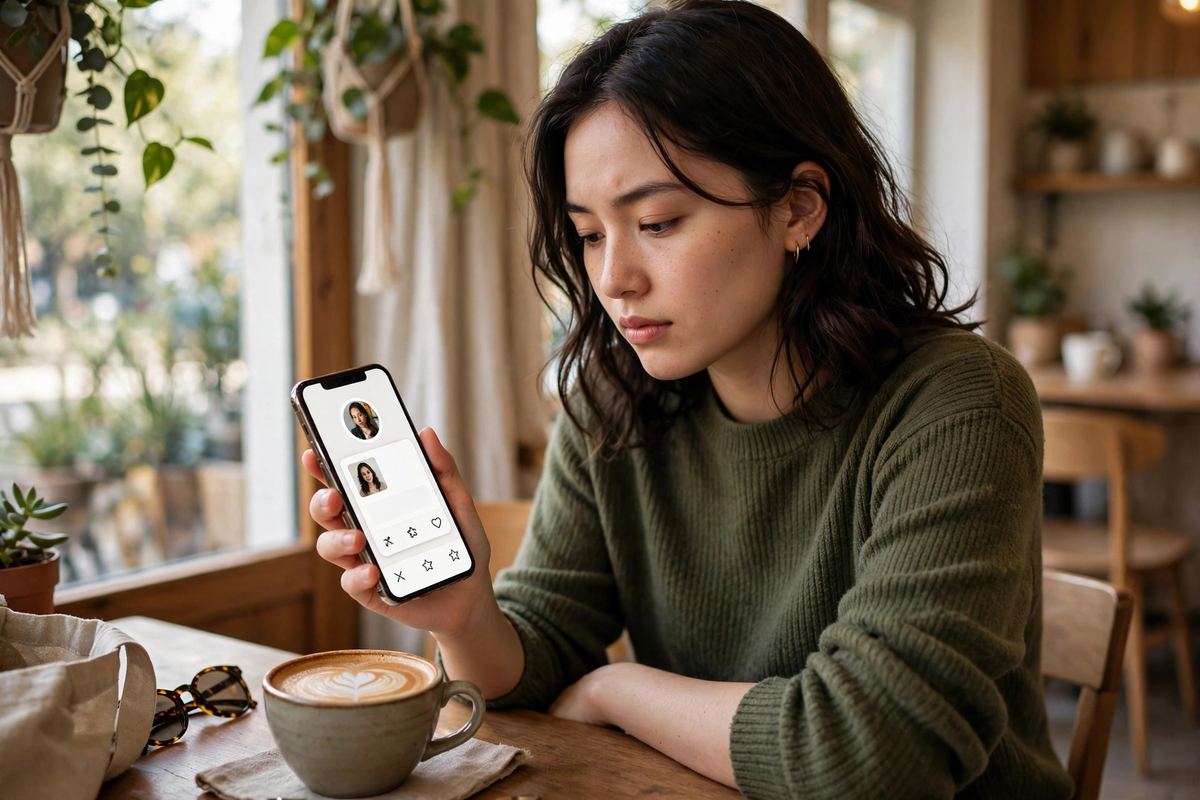
Slow down and read the whole profile before you decide whether to swipe right.
This guide is deliberately narrow, and that narrowness is its strength. It is not about red flags in a boyfriend, a partner, or a relationship that has already started. Those behaviour-based warning signs belong to a different conversation, and this article links to that conversation at the end. Here, we look only at what a dating profile itself shows you: the photos, the bio, the prompts, and the details a person chose to publish.
Think of it as learning to read a shop window before you walk inside. A good profile does not have to be perfect, funny, or photogenic. It has to be consistent, human, and specific enough that you can picture a real person behind it. A worrying profile, by contrast, often feels strangely smooth, strangely empty, or strangely urgent. None of those feelings is a verdict on its own, but together they are information, and you are allowed to act on information.
Sara, whose name I have changed, told me she used to swipe on photos alone and then spend three weeks untangling every match. One match claimed to be a local teacher but could never name his school, sent only studio portraits, and moved the chat to another app within ten minutes. She stayed because he was charming. The story ended with a request for money for a sudden emergency, and with Sara feeling foolish for ignoring what she had seen on day one. She was not foolish. She simply had not yet learned to trust the evidence on the screen.
This article gives you that skill in plain language. You will meet all 14 warning signs, grouped so you can check them in under five minutes. You will also get a comparison table that separates a one-off quirk from a real pattern, a numbered safety check, polite scripts for stepping back, and the green flags that say a profile is worth a proper hello. Keep this guide open next time you swipe, and let the profile prove itself before your heart gets involved.
Quick Jump
📸 Dating Profile Red Flags to Avoid: Photos That Raise Questions
Photos are the first thing you see, and they are also the easiest place to hide. A genuine person usually has a mix: a clear face photo, a couple of everyday shots, maybe a hobby, a laugh, or a slightly awkward picture a friend took. That mix is reassuring not because it is beautiful, but because it looks lived in. When every photo looks like it came from the same professional shoot, with perfect lighting and no ordinary moments, pause and ask yourself what is missing.
Flag 1, Only one photo, or no clear face at all. A single photo gives you nothing to compare, and a profile full of sunglasses, distant landscapes, pets, or the back of a head gives you even less. There are innocent reasons for a thin gallery, such as shyness or a new account, but a person who wants to be known usually adds a second clear photo once they are serious about dating. If the gallery stays empty after you ask kindly, treat that as information, not as a mystery to solve.
Flag 2, Photos that look too polished to be real. Magazine-style portraits with no casual selfies, no friends, no variation in setting, and no sign of an ordinary day are a classic warning sign. Cybersecurity expert Polycap Oliver Oluoch Ochieng has warned publicly that if the photos are all professional and there are no casual selfies, no photos with friends or family, and no variation whatsoever, it is a silent red flag. Modern tools can now generate realistic fake faces, so beauty alone proves nothing. Look for texture: a creased shirt, a messy kitchen, a rainy-day walk.
Flag 3, Photos that do not match the story. A profile that claims a modest office job but shows a yacht, a sports car, and five-star hotels in every frame deserves a gentle question, not instant belief. The same applies to photos that look like they belong to different people, different ages, or different decades. One old photo is normal. A whole gallery that cannot agree on who this person is today is not. A reverse image search on a suspicious photo can reveal pictures stolen from models or influencers, and it takes less than a minute.
A kind rule
Never accuse someone of faking photos on the first message. Say something simple, such as: “Your photos are lovely, do you have a recent everyday one too?” A real person can usually laugh and send one. A fake profile often changes the subject, gets defensive, or disappears. The reaction tells you as much as the photo did.
Age and recency matter more than attractiveness. If every photo looks ten years younger, or if the person refuses to say when a photo was taken, you are not being picky by noticing. You are protecting the most basic fact of dating: that you know who you are actually talking to. Attraction can grow, but trust cannot grow on a face you have never really seen.
Finally, watch for group-only photos where you cannot tell who the profile belongs to, and for photos that are all cropped so tightly that context vanishes. These choices can be innocent, but combined with an empty bio they form a pattern. A profile that hides the person while advertising the lifestyle is asking you to fall for an image, not a human being.
🪞 Dating Profile Red Flags to Avoid: The Almost-Empty Profile
An almost-empty profile with a very attractive photo and no real details is one of the most common dating profile red flags to avoid, and it is easy to understand why it works. Your imagination fills the gaps with everything you hope for, while the profile itself commits to nothing. A real person usually leaves at least a few fingerprints: a job described in ordinary words, a city they actually live in, a hobby they can talk about, or a prompt answered with a specific detail.
Flag 4, A bio that says nothing at all. “Just ask,” “Here for vibes,” or a completely blank bio is not mysterious; it is untestable. You cannot tell whether this person shares your values, your humour, or even your timezone. Genuine daters do not need to write an essay, but they can usually answer one simple question: what does a good weekend look like for you? If the bio cannot answer that, the first chat will have to do all the work, and that is often where the inconsistencies begin.
Flag 5, Vague work, vague place, vague life. Job descriptions like “entrepreneur” or “consultant” with no company, no field, and no detail a real professional could explain are worth a second look. Real professionals can usually say what they do in a sentence, even if they keep their employer private. The same applies to location: a person who claims your city but cannot name a neighbourhood, a favourite café, or how long they have lived there may not live there at all. Vagueness is not proof of deception, but it removes every easy way to check.

An empty bio asks your imagination to do all the work, a real profile gives you something concrete to respond to.
Prompts deserve the same attention as the bio. A prompt answered with a joke is fine. Every prompt answered with a joke, a shrug, or a copy-paste line suggests the profile was built in a hurry, possibly by someone running many profiles at once. Look for one answer that could only come from this person: a specific film, a local place, a small opinion. Specificity is the cheapest form of honesty, and its absence is noticeable once you start looking for it.
It helps to separate shyness from emptiness. A shy person writes little but answers warmly when you ask a real question, and their answers add detail over time. An empty profile stays empty: your questions bounce off, the answers stay generic, and the conversation drifts back to compliments. If three kind, specific questions still produce no specific answers, you have learned something real, and you do not need a fourth question to act on it.
Try this
Before you swipe right on a thin profile, write down one thing you actually know about this person from the profile alone. If the list is blank, or if it contains only their looks, wait. Attraction is a reason to look closer, not a reason to ignore an empty page.
📝 Dating Profile Red Flags to Avoid: Bio Tone That Warns You Early
Tone is information. A profile is a small advertisement for how a person treats other people, and the words they choose when nobody is watching are often more honest than the words they choose on a first date. Warm, specific, and good-humoured bios do not guarantee a good partner, but hostile, bitter, or controlling bios rarely hide a gentle person. Read the tone as carefully as you read the photos.
Flag 6, Every ex was terrible. A bio that calls all exes “crazy,” lists grievances, or turns the whole profile into a warning about past partners is telling you how this person handles responsibility. Most adults have a difficult story or two, but a person who takes no share of any past ending is likely to repeat that pattern with you. A single honest line about learning from a breakup is very different from a paragraph of blame. The first shows reflection. The second shows a script.
Flag 7, Demands disguised as standards. “No drama, no games, no time-wasters, no ugly people, swipe left if...”, a long list of rejections before a single hello is a warning sign in itself. Healthy standards sound like preferences: what someone enjoys, what they value, what they hope to build. A wall of bans sounds like control, and it often comes with a test: will you prove you are worthy before you have even spoken? You do not need to pass a test to deserve a respectful conversation.
Watch also for prompts that sexualise immediately, mock whole groups of people, or joke about lying, cheating, or ghosting as if those were personality traits. Humour is personal, and one edgy joke is not a verdict. A profile whose humour only punches down, or whose only joke is about using people, is showing you its values. Believe the pattern, not the excuse that it was “just a joke” when you notice it for the third time.
Contempt is the tone to take most seriously. Contempt sounds like eye-rolling at entire genders, sneering at people who want commitment, or treating kindness as weakness. A person can be funny without contempt, confident without cruelty, and honest without hostility. If reading the bio leaves you feeling smaller, judged, or on edge, that feeling is data. You do not need to argue with a profile. You can simply swipe left and keep your peace.
Re-read test
Read the bio aloud as if the person were saying it to you across a table. If it sounds like someone you would enjoy coffee with, that is a green light to say hello. If it sounds like someone already annoyed with you, believe the voice you just heard.
💸 Dating Profile Red Flags to Avoid: Too Good, Too Rich, Too Urgent
Some profiles are designed to make you stop thinking. They offer extraordinary wealth, a globe-trotting lifestyle, celebrity connections, or a perfect romance, all before a single conversation. Real life is rarely that smooth, and a profile that promises a fairy tale on day one is often selling something else. Curiosity is the right response here, not excitement and not shame. Ask one practical question and watch what happens.
Flag 8, A lifestyle the stated job cannot explain. A modest salary and a private jet do not usually belong in the same story, and a bio that brags about luxury while refusing any detail about work deserves scepticism, not admiration. Genuine success can usually be described calmly, without a catalogue of brands. When the profile reads like an advertisement for wealth, ask yourself who benefits if you believe it. Often, the answer is someone who will later need your trust for a favour.
Flag 9, Money hints, investment tips, or an emergency waiting to happen. Any mention of crypto tips, trading secrets, or a business opportunity in a dating bio is a hard stop, not a conversation starter. The same applies to early chat that drifts toward fees, tickets, medical bills, or gift cards. The United States Federal Trade Commission reported that romance-scam losses reached $1.14 billion in 2023, and guidance cited by AARP notes that scammers often push conversations off dating platforms early, away from the reporting tools those platforms provide. A genuine match will never ask you for money, however convincing the story sounds.
Urgency is the engine of most of these profiles. A sudden deployment, a frozen account, a sick relative, or a once-in-a-lifetime deal all create the same pressure: decide now, think later. Real emergencies do happen, but a person you met yesterday is not the right person to fund them, and a real partner would not want you to. If urgency appears, slow down on purpose. Tell a friend the whole story out loud. Scam stories often sound much thinner when spoken to someone who is not emotionally involved.
Never send
Never send money, gift cards, crypto, bank details, or intimate photos to someone you have only met through a profile, no matter how urgent or romantic the request feels. If a request like this appears, stop the conversation, save screenshots, and report the profile on the app. Reporting protects the next person who sees the same photos.
It is worth saying plainly: falling for a polished story does not make you naive. These profiles are built by people who practise them all day, and they are designed to exploit hope, loneliness, and kindness, three good qualities. The protection is not cynicism. It is a simple habit: believe the lifestyle only when the details, the photos, and the conversation all agree, and never let urgency replace verification.
🕵️ Dating Profile Red Flags to Avoid: Details That Do Not Add Up
Consistency is the quiet test that fake profiles most often fail. Real people misremember small things, but their core facts stay stable: their age within a year or two, their city, their job in broad terms, and the shape of their daily life. When those facts slide around, you are not dealing with forgetfulness. You are dealing with a story that was never properly built, or with several people operating one account.
Flag 10, Age, location, or job details that shift. A profile that says 35 but references events from decades ago, or a match who says they live in your city on Monday and mentions another country on Thursday, has a problem you did not create. Grammar that switches between native and non-native patterns inside one conversation can also suggest more than one person is writing. Small slips are human. Repeated, convenient changes are a pattern, and patterns deserve a pause.
Flag 11, The same bio, word for word, everywhere. Copy-paste bios, identical prompt answers across different profiles, or a profile that appears under different names with the same photos all point to mass-produced accounts. Real people repeat themselves sometimes, but they do not repeat an entire personality. If a reverse image search or a distinctive phrase search shows the same profile in several places, trust the search over the charm of the chat.
Cross-checking is not spying. It is the online equivalent of meeting someone's friends or seeing their workplace, ordinary context that dating apps partly remove. A quick check of a public social profile, a company page, or a photo search is reasonable before you share personal details or agree to meet. What you are looking for is not perfection. You are looking for a life that exists outside the app, with history, connections, and details that agree with each other.
Fresh accounts deserve extra care, not automatic rejection. A genuinely new account has little history by definition, and a person returning to dating after years may look new too. The difference is transparency: a real newcomer can explain why the account is new and can offer a video call or a public meeting without drama. A fake account treats every reasonable check as an insult. Notice which response you get, because that response is the real test.
Keep a note
When details start shifting, write down the original claim and the new claim, with dates, in your own notes app. Memory softens under charm; a written note does not. If you later need to report the profile, that note is also useful evidence.
🔍 Dating Profile Red Flags to Avoid: Verification Dodges
A dating profile is a promise that a real person exists behind it. Verification is simply asking that promise to be kept in a small, safe way: a live video call, a recent photo with a gesture you choose, or a meeting in a public place. Genuine interest usually welcomes a face-to-face conversation once trust starts building. Repeated refusal is therefore one of the clearest dating profile red flags to avoid, and it matters more than any single excuse.
Flag 12, Always an excuse for video calls and meetings. A broken camera, a work trip, a family emergency, a bad connection, each excuse alone can be true, but an ever-changing list of reasons that never ends is a pattern. A person who is deployed overseas, working on an oil rig, or travelling constantly can still usually manage a short live call. If weeks pass and every attempt at live contact fails, you do not have a relationship yet. You have a story about one.
Video calls deserve care, because modern fake profiles can use AI-generated faces and even deepfake video. A single call is not absolute proof, which is why behaviour still matters more than appearance: does the person answer questions consistently, react naturally, and agree to meet in public when it becomes reasonable? Combine a call with a public meeting, and with the consistency checks from the previous section, rather than treating any one check as final.
A related dodge is the refusal to share any verifiable detail at all: no social profile, no workplace in general terms, no friend who knows they are dating, no photo taken today. Privacy is legitimate, and nobody owes you their full identity on day one. But privacy that never loosens, even as the conversation deepens and a meeting is discussed, is not privacy. It is concealment, and concealment before a first meeting is a reason to stop, not a reason to try harder.
Safe verification script
Try this: “I enjoy chatting with you. Before we plan anything, could we do a quick video call this week? It helps me feel comfortable.” A warm yes, or a specific alternative time, is a green flag. Anger, guilt-tripping, or another vague excuse is your answer.
⚠️ Dating Profile Red Flags to Avoid: Pressure, Pace and Secrecy
Some warning signs do not live in a single photo or bio line. They live in the pressure a profile creates the moment you match: move faster, share more, keep this secret, decide now. Healthy dating has a pace you can both breathe at. Pressure that removes your breathing room is not passion. It is a tactic, and it works best on people who are kind enough to worry about disappointing someone.
Flag 13, Love-bombing built into the profile. Declarations of deep devotion, soulmate talk, and future plans within days of first contact, before any real conversation, are a common scam pattern and a common manipulation pattern alike. Genuine connection tends to build gradually, through consistent, everyday conversation. A bio that already calls you “the one” before knowing your surname is not romantic. It is trying to create an emotional debt you have not agreed to owe.
Flag 14, Off-app pressure and secrecy. A bio that says “not on here much, message me on another app” or lists a handle straight away is asking you to leave the platform's reporting and blocking tools behind. Guidance cited by AARP makes the same point: scammers often push conversations off dating platforms early, away from those protections. Add secrecy, “don't tell anyone about us yet”, and the picture sharpens further. A real connection does not need to hide from your friends in its first week.
Early sexual pressure belongs in this group too. If a profile, or the first messages it produces, keep returning to sexual topics after you have changed the subject, that is not chemistry. It is a boundary test, and failing to respect a small boundary early predicts how larger boundaries will be treated later. You do not need to debate this. A clear “I am not comfortable with that yet” followed by pressure, sulking, or insults is a complete answer.

Talking a profile through with a friend often makes a pattern obvious in minutes.
Disappearing and suddenly coming back also fits here when it is paired with profile secrecy. A match who vanishes for days, then returns as if nothing happened, while still refusing any verification, is keeping you in a loop where you do the emotional work and they keep the control. You are allowed to break that loop by simply not replying. Silence is not rudeness when it follows repeated boundary-pushing. It is self-respect.
If any of this feels familiar, remember that the profile stage is the cheapest place to leave. Leaving a profile costs you nothing but a match. Leaving a relationship built on pressure costs far more. That is why this guide spends so much time on early signs: the earlier you notice pressure, the less it costs you to walk away from it.
🛡️ Dating Profile Red Flags to Avoid: Your 5-Minute Profile Check
You do not need to become a detective to date safely online. You need a short routine you actually use, every time, before feelings get involved. This numbered check takes about five minutes, and it works best when you do it before you reply with anything personal. Save it on your phone, and run through it like a pilot's checklist: calm, boring, and effective.
- Count the photos. Is there a clear face photo plus at least one everyday shot? If not, note flag 1 or 2.
- Read the bio out loud. Does it say anything specific about this person? If not, note flag 4 or 5.
- Check the tone. Is it warm and specific, or bitter, hostile, or a wall of bans? If the latter, note flag 6 or 7.
- Test the lifestyle. Does the job, the photos, and the lifestyle agree? If not, note flag 8.
- Look for shifts. Compare the profile with the first messages. Has age, place, or job already changed? If yes, note flag 10.
- Ask for a live moment. Suggest a quick video call before any meeting. A warm yes is a green flag; endless excuses are flag 12.
- Stay on the app. Do not move to another app, share personal details, or send anything of value until steps 1 to 6 feel steady.
Score the check honestly: zero or one small flag with good answers elsewhere is usually fine, especially if the person responds warmly to a kind question. Two or three flags, or any single hard flag such as a money request, an investment tip, or a refusal to verify, means slow down or step back. You are not judging a person's worth. You are deciding whether this particular profile has earned more of your time.
| What you see | Probably just a quirk | A real pattern to act on |
|---|---|---|
| One old photo | One favourite photo from two years ago, plus recent everyday shots | Every photo looks years old and no recent photo can be produced |
| Short bio | Brief but specific, and answers add detail when you ask | Blank or copy-paste bio that stays empty after kind questions |
| Strong opinions | One clear preference, stated warmly | A wall of bans, contempt for whole groups, or blame for every ex |
| Busy schedule | One missed call, then a specific alternative time offered | Weeks of changing excuses for every video call and meeting |
| Fast affection | Warm enthusiasm that respects your pace when you slow it down | Soulmate talk in days, pressure to move off the app, secrecy from friends |
Keep the table's distinction in mind whenever you feel torn. A quirk has an explanation and a correction: the person adds a photo, answers a question, or offers a time. A pattern has excuses and repetition: the same problem appears in a new form each time you raise it. Quirks deserve patience. Patterns deserve distance. Learning that difference is the whole skill this article is trying to teach.
💬 Dating Profile Red Flags to Avoid: What to Say When You Step Back
Knowing a profile is worrying is only half the skill. The other half is leaving without a fight, a long explanation, or a guilt spiral. You do not owe a stranger a detailed verdict on their profile, and a detailed verdict rarely changes anything. Short, kind, and final works better than honest, long, and open to negotiation. These scripts are yours to copy, adapt, or ignore.
For a simple mismatch, try: “Thanks for chatting, I don't think we're the right fit, but I wish you well.” Then unmatch. You do not need to list the flags, prove your case, or wait for permission. For a profile that pressured you, a shorter exit is fine: “I'm going to step back here. Take care.” Then block if the pressure continues. Blocking is not rudeness. It is a boundary, and boundaries do not require a debate.
If you suspect a scam, do not argue with the account and do not send anything further. Save screenshots of the profile and the messages, report the profile inside the app, and tell a trusted friend what happened. If money or personal details were shared, contact your bank and the relevant fraud-reporting service in your country promptly, and keep the screenshots. Reporting feels small, but it is how platforms spot the same photos and stories being reused on the next person.
Raising a concern inside a real conversation is a different skill, and 17 Easy Ways to Improve Couples Communication and The Complete Guide to Healthy Communication in Relationships both cover how to say a difficult thing without turning it into a fight. The principle is the same on a dating app: one clear sentence, one specific observation, and then watch the response. A person who can hear a concern calmly is showing you something valuable. A person who turns a gentle question into an attack is showing you something too.
Finally, be kind to yourself after stepping back. It is normal to feel a pang, especially if the profile was attractive or the early chat was fun. That pang does not mean you made a mistake. It means you liked an idea, and you chose evidence over the idea. That choice gets easier every time you make it, and it leaves your time free for profiles that can pass a simple, fair check.
🌿 Dating Profile Red Flags to Avoid: Green Flags Worth a Hello
A guide about warning signs should end its middle, not its message, on hope. Most profiles are not scams. Most are ordinary people, a little awkward, trying to describe themselves in a few photos and a few lines. Knowing what a good profile looks like helps you say yes with confidence, instead of treating every match as a suspect. These green flags are the mirror image of the 14 warnings, and they are worth looking for.
A trustworthy profile usually shows a clear face photo plus everyday pictures, a bio with at least one specific detail, and prompts answered in the person's own voice. It names a job in ordinary words, a city it can actually describe, and a hobby it can talk about beyond one line. It is warm without being intense, funny without being cruel, and clear about what it hopes for without issuing a list of bans. None of this is glamorous, and that is exactly the point.

Choosing a profile that feels real, and leaving one that does not, is a skill that gets easier every time.
In conversation, green flags look like consistency, curiosity, and respect for pace. The person answers your questions, asks you real ones in return, accepts a video call without drama, and agrees to meet in a public place when the time is right. They remember what you said, they do not rush you off the app, and they do not make you feel guilty for taking your time. If a profile and a conversation both show these signs, you have good reason to enjoy getting to know someone.
If the conversation later moves toward distance, Is Long Distance Worth It? is a useful next read, because it asks honestly whether a long-distance connection is worth the effort. For now, though, the task is simpler: enjoy the profiles that feel human, specific, and steady, and let the rest go without apology. Your attention is valuable, and a good profile earns it by being real, not by being flawless.
❓ Dating Profile Red Flags to Avoid: Questions People Ask
How can you tell if a dating profile is fake?
No single sign proves a profile is fake, but a pattern does: only one or stock-perfect photos, an empty or copy-paste bio, details that change, pressure to move off the app, and endless excuses for video calls or public meetings. Check photos with a reverse image search, ask one specific question, and suggest a quick video call. A real person usually passes at least two of those three checks without drama.
What are the biggest red flags in dating profile photos?
The biggest photo warnings are no clear face photo, only one photo, all photos looking like a professional shoot with no everyday shots, photos that look like different people, and photos that do not match the stated age, job, or lifestyle. One old or imperfect photo is normal. A whole gallery that hides the person while advertising a lifestyle is not.
Is an empty bio a red flag?
An empty bio is a yellow flag that becomes red when it stays empty. A shy person writes little but adds detail when you ask warm, specific questions. A worrying profile stays generic no matter what you ask, because there is no real person behind the details to add. If three kind questions still produce no specifics, treat that as your answer.
Should you move off the dating app to WhatsApp or another app?
Not in the first days, and not because the profile insists. Dating apps have reporting and blocking tools that disappear once you move elsewhere, which is exactly why scam profiles push for the move. Stay on the app until you have had a video call, the details have stayed consistent, and a public meeting feels reasonable.
What should you do if a match asks for money?
Stop the conversation, send nothing, save screenshots, and report the profile in the app. A genuine match will never ask you for money, gift cards, crypto, or bank details, however convincing the emergency sounds. If you already sent money or details, contact your bank and your country's fraud-reporting service promptly and keep your evidence.
Can a real person have only professional photos?
Yes, occasionally, for example, someone who rarely takes selfies but has headshots from work. The difference is what happens when you ask: a real person can usually share an everyday photo, explain the context, and agree to a video call. A fake profile changes the subject, gets defensive, or produces yet another polished image instead of an ordinary one.
How do you politely reject someone with red flags?
Keep it short and final: thank them, say you do not think you are the right fit, wish them well, and unmatch. You do not owe a list of reasons or a debate. If pressure continues, block without further explanation. Blocking after a clear exit is a boundary, not rudeness.
What is the difference between profile red flags and relationship red flags?
Profile red flags are visible in the profile itself: photos, bio, prompts, and listed details, before you really know the person. Relationship red flags are behaviours that appear once you are dating, such as control, contempt, or repeated dishonesty. This article covers only the first kind. For the second kind, read the behaviour-based sibling linked below, which covers warning signs in a relationship itself.
That distinction matters enough to repeat: if you matched someone and the worry is about how they treat you in conversation or on dates, the right next read is Red Flags in Relationships: 15 Warning Signs You Should Never Ignore. If the worry is about what their profile shows, or fails to show, you are in the right place, and the 14 signs above are your checklist.
📌 Dating Profile Red Flags to Avoid: A Calm Summary
Dating profile red flags to avoid are not about finding a perfect person. They are about noticing, before your heart gets involved, whether a profile shows a real, consistent, specific human being. Photos that hide the person, bios that say nothing, tones that blame or demand, lifestyles that do not fit the job, details that keep changing, refusals to verify, and pressure to move fast or move off the app are the 14 signs to watch. One small oddity is usually just a quirk, and a kind question often clears it up. A pattern of two or three signs, or any hard sign like a money request, is your cue to slow down, verify, and step back politely if the answers do not add up. On the other side, clear photos, specific bios, warm tone, steady details, and a willingness to video-call and meet in public are green flags worth a hello. Trust the profile that earns your trust, not the one that demands it, and keep your attention for the people who prove, in small ordinary ways, that they are who they say they are.