
How long should the talking stage last? If you have been texting someone for weeks and still have no idea where it is going, you are asking the right question. The talking stage is that strange in-between space where you are not strangers, but you are not a couple either.
Quick Answer
How long should the talking stage last? Most relationship experts and dating coaches put the sweet spot at one to three months: enough time to meet in person several times, see each other in different settings, and learn how someone handles ordinary life. Past three months with no direction, the timeline is no longer the issue. The other person's intentions are.
- Weeks 1 to 4: Meet in person and check consistency, so you can judge how long should the talking stage last for you in real life.
- Weeks 5 to 8: Look for plans that stretch further ahead and a direction you can name.
- Weeks 9 to 12: Ask for clarity, because after three months you should know how long should the talking stage last before it either grows or ends.
| Timeline | What it means |
|---|---|
| Under 4 weeks | Too early to decide anything serious. |
| 4 to 12 weeks | The healthy range, if dates and effort keep growing. |
| Over 12 weeks with no direction | Time to ask for clarity, not to wait longer. |
Evidence to trust: Relationship researcher John Gottman identifies contempt as a strong predictor of breakup, which is why calm, early clarity matters. Attachment researchers, including Amir Levine and Rachel Heller, note that clear communication calms anxiety better than guessing. Both points support a short, honest check in, rather than months of silence.
Most healthy timelines land between four and twelve weeks. That range sounds wide, but it exists for a reason. Some connections clarify fast because both people are ready, while others need time because life is complicated. What matters is not the exact number of days. What matters is whether the talking stage is moving forward or quietly stalling.

A couple walking together at golden hour, their faces not visible.
Under one month is often too early to decide anything serious. You are still in the highlight reel phase. Everyone is on their best behavior, conversations are exciting, and you have not yet seen how this person acts when they are tired, stressed, or disappointed.
Beyond three months without any movement toward clarity, the picture changes. At that point, you are usually not in a talking stage anymore. You are in a holding pattern. And holding patterns rarely turn into relationships on their own.
Think of it like a job interview process. A company that interviews you for two weeks is being thorough. A company that keeps you in interviews for five months is not thorough. It is indecisive, or it already filled the role and forgot to tell you.
When friends ask how long should the talking stage last, give them the simple version. One to three months with real dates and real effort. If it is past that with no direction, the timeline is no longer the issue. The other person's intentions are.
💡 What the Talking Stage Actually Is, and How Long Should the Talking Stage Last for It
The talking stage is the phase before dating officially begins. You have matched, met, or reconnected somehow, and now you are talking regularly. There are texts, maybe calls, maybe a few casual dates. Nobody has said the words boyfriend, girlfriend, or partner yet.
It is different from casual dating. Casual dating usually involves actual planned dates with romantic intent. The talking stage is looser. It might be mostly texting with the occasional hangout. The defining feature is uncertainty about where it is headed, and that uncertainty is exactly why people ask how long should the talking stage last.
It is also different from a situationship. A situationship is what happens when the talking stage never graduates. The talking stage is a hallway. A situationship is when you move into the hallway and start paying rent.
How long should the talking stage last before it either becomes something or ends? The honest answer depends on three things. First, how often you actually see each other in person. Second, whether both people are emotionally available. Third, whether the effort is moving in one direction or just circling.
A talking stage built on daily texting but only one date in two months is not really a talking stage. It is a texting habit. Real life is where people reveal themselves. No amount of good morning texts replaces seeing someone across a dinner table.
Once you know what a talking stage is, the difference between a healthy one and a stalled one becomes easy to spot. Here they are side by side.
| A healthy talking stage | A stalled talking stage |
|---|---|
| Plans get made further in advance | Same vague plans, same undefined status |
| Someone genuinely interested makes seeing you a priority | The effort only flows one way |
| The future tense sneaks into conversations | The future is always vague |
| You meet their friends; you are not a secret | Total social invisibility after months |
| Growth is the hallmark; the dynamic keeps changing | Nothing has changed in a month |
| Exclusivity gets discussed openly, never assumed | The label conversation terrifies them |
📅 How Long Should the Talking Stage Last: A Week-by-Week Timeline
A vague timeline helps nobody, so here is a concrete map. These are not strict rules. Think of them as mile markers. If you are way behind the markers with no good reason, that gap is information. Whenever you wonder how long should the talking stage last, come back to these markers and compare honestly.
Weeks 1 to 2: The Discovery Phase
The first two weeks should feel light and curious. You are learning the basics. What they do, what they care about, how they spend a normal Tuesday. Texting should feel natural, not forced.
By the end of week two, you should have a sense of whether you actually enjoy this person or just enjoy the attention. A healthy sign is that you have met in person at least once, or a first meeting is firmly planned.
Maya, 26, told me she once texted a guy for three weeks before they met. The conversation was electric. In person, he barely looked up from his phone. She ended it that night. Three weeks of great texting could not survive one real dinner. That is why early in-person meetings matter so much.
A warning sign this early: conversations that never leave the surface. If after two weeks you still do not know what this person does for fun or what they want in life, the talking stage is shallow, and shallow rarely deepens on its own. Two weeks is too early to decide how long should the talking stage last in total, but it is never too early to judge effort.
Weeks 3 to 4: The Evaluation Zone
This is where the talking stage either gets real or starts drifting. By now you should have been on two or three actual dates. You should know each other's friends exist, even if you have not met them.
Pay attention to consistency. Does this person text the way they did in week one? Do plans actually happen, or do they keep dissolving into rain checks? Someone who is genuinely interested makes seeing you a priority, not a puzzle.
This is also when small conflicts or inconveniences appear. A rescheduled date. A misunderstood text. How someone handles a minor friction tells you more than a hundred perfect conversations. Grace under small pressure predicts grace under big pressure.
If you are following 15 Dating Tips for Women: Rules for Confident Dating, this is the window where they pay off. Boundaries set in weeks three and four filter out people who were only ever going to waste your spring.
Weeks 5 to 8: The Decision Window
Somewhere in this stretch, a healthy talking stage starts developing a direction. You might not be official, but you feel the pull toward something. Plans get made further in advance. The future tense sneaks into conversations.
This is also when you learn how someone treats you when the novelty fades. The butterflies calm down. What is left is either genuine liking or a slow fade. Both are useful answers, even if only one feels good.
Daniel, 31, described his talking stage with his now-wife. Around week six, he realized he was rearranging his schedule to see her. Not out of anxiety. Out of wanting to. He told her he was not talking to anyone else. She said the same. Nobody declared anything official. The direction was simply obvious, and that is how long should the talking stage last when it is working: exactly as long as it keeps moving forward.
A stalled sign in this window: the dynamic has not changed since week three. Same texting rhythm, same vague plans, same undefined status. Growth is the hallmark of a living connection. A talking stage that looks identical at week eight and week three is not patient. It is parked.
Weeks 9 to 12: The Clarity Deadline
By three months, you know enough. You have seen this person across enough ordinary days to make an informed choice. Anyone who says they still have no idea what they want after three months of regular contact is telling you exactly what they want. They want the current arrangement to continue unchanged.
This does not mean you must be in a labeled relationship by day ninety. It means the question should be on the table. A conversation about where this is going should have happened, or should be about to happen.
Life sometimes justifies a slower pace. Long distance, a recent breakup, a genuinely chaotic season. These are real reasons. But a reason is different from an excuse. A reason comes with a timeline. An excuse comes with another month of maybe.
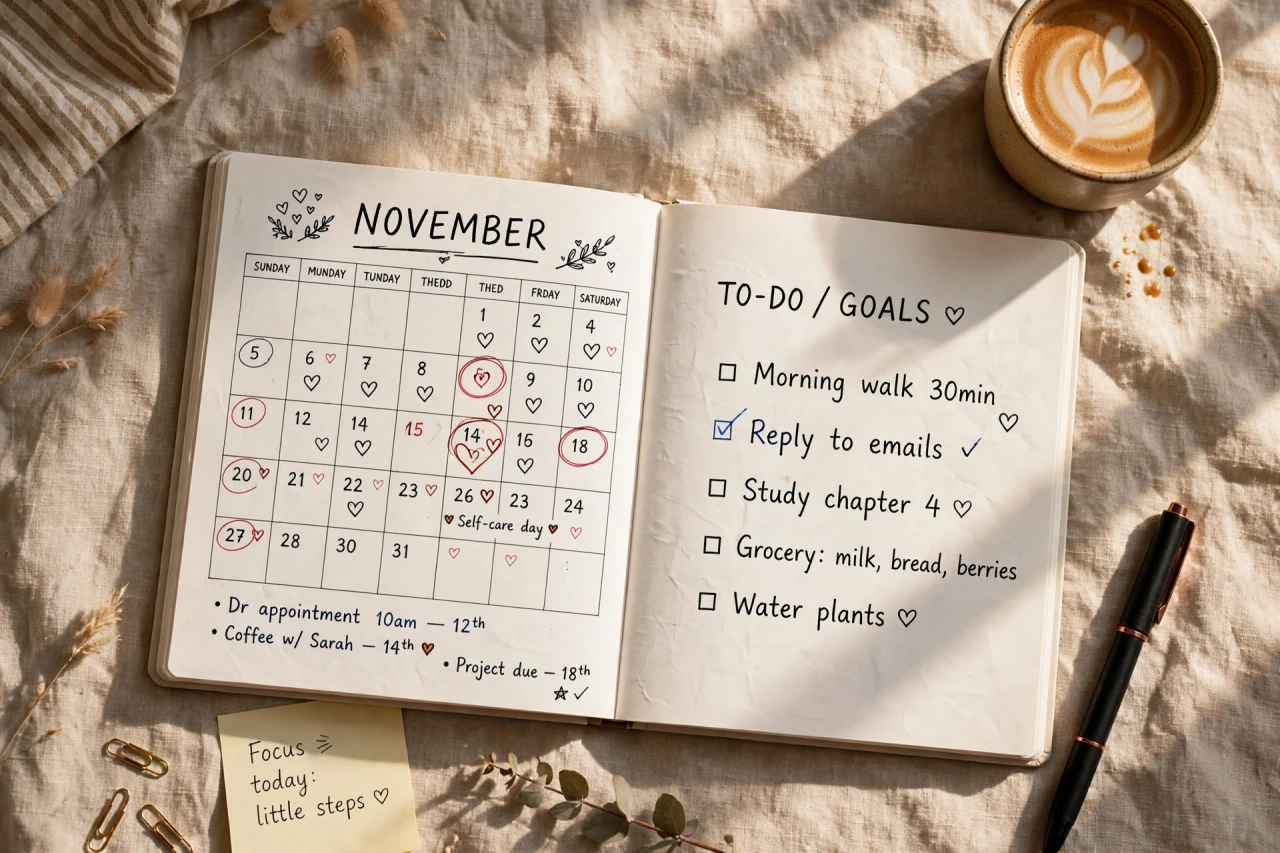
A desk planner calendar with heart doodles marking a timeline.
🔒 How Long Should the Talking Stage Last Before Exclusivity?
Exclusivity and a label are two different things. You can agree to stop seeing other people without calling yourselves a couple. Many healthy connections do exactly this. The exclusivity conversation often happens before the label conversation.
So how long should the talking stage last before exclusivity enters the chat? Usually around the one to two month mark. By then, if you are seeing each other weekly and the connection is growing, it is reasonable for one of you to say the words out loud.
Here is the critical part. Exclusivity must be discussed, never assumed. One of the most common heartbreaks in modern dating is discovering that your exclusive talking stage was only exclusive on your side. A five minute conversation prevents months of confusion.
A simple way to raise it: say you are enjoying where this is going and you are not talking to anyone else, then ask if they feel the same. No pressure, no ultimatum. Just information. How they respond tells you everything about how long the talking stage should last for the two of you.
If they agree, the talking stage now has a direction. If they dodge, deflect, or say they are not ready to have that conversation yet, believe the dodge. That single response often settles how long should the talking stage last for the two of you, because someone who wants you does not treat a basic question like a trap.

Two coffee cups and phones face down on a cafe table.
🚪 How Long Should the Talking Stage Last Before You Walk Away: 7 Signs It Has Stalled
Walking away from a talking stage hurts in a specific way. You grieve something that never officially existed. But staying in a stalled one costs more. When people ask how long should the talking stage last, these seven signs are the honest answer. Here are the signs that the talking stage has lasted too long and is going nowhere.
- 1. The effort only flows one way. You plan the dates. You start the conversations. You ask the questions. They participate warmly but never initiate. After a month of this, you are not in a talking stage. You are in a one-person show with an audience of one.
- 2. Plans keep evaporating. Everyone cancels sometimes. But if rescheduling has become the main activity of your connection, pay attention. A person who wants to see you finds a way. A person who likes the idea of you finds an excuse. Check for Red Flags in a Guy: 20 Warning Signs You Can't Ignore early, because charm covers a multitude of cancellations.
- 3. The future is always vague. Try mentioning something a month away. A concert, a trip, a family event. If the response is always a laugh and a subject change, they are keeping the horizon short on purpose. People who see a future with you do not flinch at next month.
- 4. You have never met anyone in their life. By month two or three, someone serious introduces you to at least one friend. Total social invisibility after months of talking is a choice. It usually means they are keeping you in a separate compartment that has no door to the rest of their life.
- 5. The label conversation terrifies them. Not discomfort. Terror. If a calm, kind question about where this is going triggers anger, shutdown, or a guilt trip, you have your answer. Healthy people can discuss a relationship without treating the discussion as an attack.
- 6. You feel anxious more than you feel happy. Track your actual emotions for one week. If the dominant feeling is anxiety, confusion, or the need to decode texts like ancient manuscripts, the talking stage is costing you more than it gives. A good connection should feel mostly good, even before it is defined.
- 7. Nothing has changed in a month. Compare this week to a month ago. Same texting pattern, same date frequency, same undefined status, same vague answers. A living thing grows. If your talking stage looks identical to last month, it is not developing. It is preserved.
Priya, 29, stayed in a talking stage for seven months. He texted every day, called her pet names, and acted like a boyfriend in every way except the ones that counted. No friends met, no plans beyond the weekend, no exclusivity. When she finally ended it, he was upset for about a week. Then he was fine. That speed of recovery told her everything. She had been grieving alone for months while he had barely started.

A woman at a rainy window holding a warm mug, with city lights blurred outside.
🐢 How Long Should the Talking Stage Last When He Is Slow to Commit?
Some people are genuinely slower. They have been burned before, they take commitment seriously, or they simply process feelings at a walking pace while you process at a jog. Slowness itself is not a red flag. Slowness without direction is.
The question to ask is not how fast he moves. It is whether he is moving at all. A slow person who is moving toward you looks different from a slow person who is standing still. The first one gradually opens up, makes more plans, and shares more of his life. The second one stays exactly the same while asking for more patience.
Give a slow mover about eight to twelve weeks to show direction. That is generous. When you ask how long should the talking stage last with someone slow, the real question is whether the slowness comes with progress. During that time, watch for effort, not words. Does he remember the small things you tell him? Does he make plans in advance instead of last minute? Does he let you into his real life, not just his free evenings?
What you should not do is audition for the role of his girlfriend for months while he decides whether he wants one. That dynamic teaches him that he gets the benefits of your devotion with none of the responsibility. How to Know Your Worth as a Woman in a Relationship means refusing to be a free trial that never converts.
There is also a difference between slow and unavailable. An emotionally unavailable person is not moving slowly toward commitment. He is moving slowly away from it while keeping you close enough to enjoy. The test is simple. Tell him what you need and watch what changes. Slow movers adjust. Unavailable ones explain why adjusting is impossible.
One more honest note. Sometimes he is slow because he is not that into you, and slowness is the kindest rejection he can manage. That stings to hear. But a clear no in week four hurts less than a foggy maybe in month six. If his pace never changes no matter what you communicate, the pace is the answer.
Hands holding a glowing phone on a couch at night.
📱 How Long Should the Talking Stage Last on Dating Apps vs. Real Life?
Where you met changes the timeline. A talking stage that starts on a dating app has a different texture than one that starts through friends or in person. Neither is better, but they need different handling.
The dating app talking stage
App conversations start with almost no shared context. You are two profiles, a few photos, and some banter. This means the early weeks carry more fantasy and less reality. It is easy to build an entire relationship in your head before you have shared a single meal.
On apps, how long should the talking stage last before meeting in person? One to two weeks, maximum. If someone keeps the conversation on the app for a month without suggesting a real date, they are collecting matches, not building a connection. A person who wants to meet you finds a time within days.
The broader question of how long should the talking stage last on apps has a shorter answer than real life. Because it starts with less foundation, it should either convert to real dates quickly or end.
The app talking stage also has a shorter healthy lifespan overall. Because it starts with less foundation, it should either convert to real dates quickly or end. Four to eight weeks of mostly app messaging with rare dates is a pen pal situation, not a talking stage.
The real life talking stage
When you meet through friends, work, or shared activities, the talking stage often moves slower and that is fine. You already see this person in real settings. You have observed them around other people. The foundation is sturdier, so the timeline can stretch a bit.
Even so, real life familiarity can breed a comfortable stall. It is easy to enjoy someone's company at group events for months without ever having a real one on one conversation about where it is going. The timeline here can reasonably reach three to four months, but only if the one on one connection is genuinely deepening.
The long distance talking stage
Distance changes the math. Visits take planning and money, so the talking stage naturally runs longer. Three to six months can be reasonable here, but the quality bar must be higher. Regular video calls, real conversations about the future, and concrete plans to close the distance are non negotiable.
What does not work at a distance is an endless texting stage with no visits and no plan. If after six months there is still no trip scheduled and no discussion of how the distance ends, you are maintaining a fantasy. Fantasies are pleasant. They are not relationships.

A smartphone beside a candlelit table set for two.
💬 How Long Should the Talking Stage Last Before You Have the Talk? Scripts That Work
At some point, the talking stage needs words. Not hints, not tests, not a dramatic social media post. A real conversation. Here is how to have it without turning it into an ultimatum or an interrogation.
Pick the right moment
Have the conversation in person or on a call, never over text. Choose a calm, private moment, not right after an argument or in the middle of a great date. The goal is clarity, not pressure. A relaxed Sunday afternoon beats a tense Friday night.
Use scripts that open doors instead of slamming them
Start with how you feel, not with what they are doing wrong. Try this: I am really enjoying getting to know you, and I have noticed I am starting to want something real here. How are you feeling about where this is going?
Another gentle opener: I wanted to check in about us. I am not seeing anyone else, and I wanted to see if you feel the same way about that. This frames exclusivity as a mutual question, not a demand.
If you need something more direct: We have been talking for a while now, and I like you. I need to know if you see this going somewhere, because I do not want to keep guessing. Direct is not aggressive. Direct is respectful of both people's time.
Listen to the actual answer
People tell you the truth in these conversations more often than you expect. The problem is that we argue with the truth when we hear it. If he says he is not ready for anything serious, that is not a challenge to change his mind. That is the answer.
Watch for the difference between a real answer and a stall. A real answer sounds like: I really like you, I want to keep seeing where this goes, and I am not talking to anyone else. A stall sounds like: I just need more time, let us not put labels on a good thing, or you are overthinking this.
More time for what, exactly? That is the follow up question that separates the honest from the evasive. Someone with a real reason can name it. I just got out of something. Work is chaotic until spring. Someone with no reason can only repeat the phrase.
After the talk, watch the behavior
Words are the start, not the finish. Give it two to three weeks after the conversation and observe. This short window is the final piece of how long should the talking stage last after you have asked for clarity. Did anything actually change? Did plans get more concrete? Did you meet a friend? Did the texting get warmer or just more careful?
If the talk changed nothing, the talk was the answer. You do not need a second summit. One clear conversation followed by zero change is complete information. 12 Green Flags in a Relationship That Say He Is a Keeper show up in actions, and their absence after a direct conversation is the loudest signal of all.

A couple on a park bench at sunset having an honest conversation.
🧠 Attachment Styles and How Long Should the Talking Stage Last for Each
Your attachment style shapes how the talking stage feels to you, and it shapes how long you can tolerate uncertainty. Understanding this helps you separate your wiring from the actual situation.
Anxious attachers: the clock feels faster
If you lean anxious, three weeks of undefined talking can feel like three months. You crave reassurance, you read into response times, and uncertainty feels physically uncomfortable. Your instinct is to have the talk early to calm the anxiety.
Having the talk is fine. But notice whether you need the talk because the situation is genuinely stalled, or because uncertainty itself is unbearable to you. If it is the second one, no label will fix it for long. The anxiety will just find a new target, like whether he really meant it.
A healthier move: set your own internal timeline before the anxiety sets it for you. Decide in advance that you will check in around week six. When anxious friends ask how long should the talking stage last, this personal deadline is the most useful answer. Until then, practice tolerating the unknown. The talking stage is supposed to contain some mystery. That is what makes it a stage and not a contract.
Avoidant attachers: the clock feels slower
If you lean avoidant, you might be the one stretching the talking stage past its healthy length without realizing it. Closeness feels like pressure. Labels feel like traps. So you keep things light and undefined, and you tell yourself you are just being careful.
Ask yourself an uncomfortable question. Are you taking your time, or are you avoiding a decision? Taking your time looks like gradual opening. Avoiding looks like keeping every door slightly ajar so you can leave without a scene.
If you are the avoidant one, be honest with the other person early. Saying I move slowly but I am genuinely interested is kind. Saying nothing while enjoying their devotion is not.
Secure attachers: the natural pace
Secure people tend to let the talking stage last exactly as long as it needs to. They enjoy the getting to know you phase without rushing it, and they raise the question naturally when it feels right. If this sounds like a foreign language, it is a skill you can build, not a trait you either have or do not.
🎯 How Long Should the Talking Stage Last If You Are Dating With Intention?
Dating with intention changes the timeline. When you know you want a committed relationship and you are not interested in endless casual chapters, the talking stage gets shorter on purpose. That is not impatience. That is clarity.
An intentional dater can reasonably expect the basics to be clear within four to six weeks. Are we both looking for something real? Are we both free to pursue it? Is the effort mutual? These are not unreasonable questions at week six. They are the minimum. For intentional daters, how long should the talking stage last is a shorter question with a firmer answer.
This does not mean rushing into a relationship. It means being honest about the direction from early on. You can say on a second or third date: I am dating because I want a real relationship eventually. No rush, but I wanted you to know where I stand. That single sentence filters out months of mismatch.
Intentional dating also means you end talking stages faster. When the signs point to a stall at week five, you do not wait until month five to confirm what you already know. You thank them for the good conversations and you move on. If you need support with that part, learning How to Move On After a Breakup: 9 Phases to Freedom applies just as much to endings that never got a label. The grief is real even when the title was not.
The paradox of intentional dating is that it often leads to faster, better connections. When you are clear about what you want, you stop entertaining people who cannot give it. The talking stage stops being a waiting room and becomes what it was meant to be: a brief, exciting preview of something real.
For a confident next step, read Dating Tips for Women: 20 Smart Ways to Date With Confidence, which shows how to date with clear standards while you decide how long should the talking stage last for you.

Sunrise over a city skyline on a fresh, hopeful morning.
👥 How Long Should the Talking Stage Last Before You Tell People About Him?
There is a quieter question hiding inside how long should the talking stage last. It is the moment you wonder whether to mention him to your friends. Telling people makes it real, and making it real feels risky when nothing is defined.
A good rule: mention him casually once you have been on three or more real dates and the effort is mutual. You do not need a label to say you are seeing someone. Saying it out loud also protects you. Friends notice patterns you miss, and their outside view is often clearer than your inside hope.
Notice how he talks about you to his people, too. If after two months you are still a secret, ask why. Some people are private, and that is fair. But privacy and secrecy feel different. Privacy says not yet. Secrecy says never.
Sofia, 27, told her sister about a guy at week five. Her sister asked one question: has he introduced you to anyone? The answer was no. That single question reframed the whole talking stage for Sofia. She realized she had been treating it like a relationship while he had been treating it like an option. She had the talk that weekend. He admitted he was not ready. She walked away by week seven, sad but not shattered.
This is why the question of how long should the talking stage last matters beyond romance. An undefined stage that drags on starts affecting your friendships, your focus, and your peace. You deserve a connection you can talk about without whispering.
If you find yourself hiding the talking stage from people who love you, ask yourself what you are protecting. Usually it is not the connection. It is the hope that the connection will become something. Hope is beautiful, but it should not require secrecy.
❓ FAQs About How Long Should the Talking Stage Last
How long should the talking stage last before becoming exclusive?
Most healthy talking stages reach the exclusivity conversation around one to two months in. By then you should be seeing each other regularly and feeling a clear direction. Exclusivity must be discussed out loud, never assumed. A short, honest check in prevents the painful discovery that your exclusive stage was only exclusive on your side.
Is three months in the talking stage too long?
Three months is the upper edge of healthy for most people. At that point you have enough information to know whether this is going somewhere. If there has been steady growth, real dates, and honest communication, a little more time is fine. If nothing has changed in weeks, three months is not patient. It is stalled, and the kindest thing you can do is name it.
Can the talking stage last six months?
It can, but it rarely should. Six months of talking without clarity usually means one person is comfortable with the arrangement exactly as it is. The exceptions are real: long distance with regular visits, or a genuinely difficult life season with a clear timeline. Without a concrete reason and visible progress, six months is a situationship wearing a talking stage costume.
How do you know if the talking stage is going nowhere?
Watch for the stall signs. Effort flows one way, plans keep evaporating, the future stays vague, you have met nobody in their life, and the label question triggers defensiveness. The simplest test: compare this month to last month. If nothing has deepened or changed, the talking stage is going nowhere, and more time will not fix that.
Should you text every day during the talking stage?
Daily texting is common and fine, but it is not required and it is not proof of interest. What matters more is the quality and the follow through. Someone who texts all day but never makes plans is less interested than someone who texts twice and shows up on Friday. Never let a great texting rhythm substitute for real world effort.
Is it okay to ask what are we during the talking stage?
Yes, and it is healthy. After a reasonable amount of time, usually around six to eight weeks of regular contact, asking where things stand is mature, not needy. Anyone who makes you feel crazy for asking a calm, kind question is showing you how they handle every hard conversation you will ever need to have with them.
What is the difference between the talking stage and dating?
The talking stage is the phase before dating officially begins. It is looser, often text heavy, with undefined status and no labels. Dating usually involves planned romantic outings with clearer intent. The talking stage asks: do we click? Dating asks: does this work? One naturally leads to the other when both people are genuinely interested.
How do you end a talking stage that is going nowhere?
Be brief, kind, and final. A short message works: I have enjoyed talking with you, but I do not feel this heading where I want to go, so I am going to step back. Wishing you well. Then actually step back. No long debates, no friendship offers you do not mean, no checking their stories for a month. Clean endings heal faster than slow fades.
✅ Summary: How Long Should the Talking Stage Last in 2026
How long should the talking stage last? Four to twelve weeks covers almost every healthy scenario. Under a month is too early to decide, and past three months without movement is too long to wait. The number matters less than the direction.
A healthy talking stage grows. Dates become more frequent, conversations go deeper, plans stretch further into the future, and at some point someone says what you are both already feeling. A stalled talking stage repeats. Same texts, same vague plans, same undefined status, month after month.
Your job is not to wait perfectly. Your job is to notice honestly. Track the effort, not the promises. Have the conversation once, clearly and kindly. Then watch what changes. If nothing does, you have your answer, and the bravest thing you can do is act on it.
The talking stage is meant to be a beginning, not a residence. Give it a fair chance, give it a fair timeline, and then give yourself the clarity you deserve.