
You said something you cannot unsay, or did something you cannot undo, and now the silence between you and your boyfriend feels heavier than the fight itself. Learning how to apologize to your boyfriend sincerely is the difference between a wound that heals stronger and a crack that quietly spreads. A thrown-out sorry patches nothing. A sincere apology rebuilds.
💡 Quick Answer: How to apologize to your boyfriend sincerely: name what you did, own it without a footnote, show real remorse, offer a concrete repair, and prove the change over 14 days. Deliver it once, fully, without a footnote, in the window a few hours to a day after the incident, then prove it over the 14-day repair plan.
| Ingredient | What it means in this guide |
|---|---|
| Recognition | Name exactly what you did, not whatever you did. |
| Responsibility | Own it without a footnote such as but you also. |
| Remorse | Show him you feel the weight of it; let his pain register with you. |
| Restitution | Offer a real repair, not a bribe. |
| Reform | Say what will be different, then prove it. |
This guide walks you through exactly how to apologize to your boyfriend sincerely, step by step. You will learn the five ingredients every real apology needs, the timing rules most women get wrong, ten word-for-word scripts for the most common situations, and a fourteen-day repair plan that turns your apology into lasting change. No groveling, no game-playing, just honest repair.

🙏 Why You Should Apologize to Your Boyfriend Sincerely Instead of Just Saying Sorry
A quick sorry is easy. You type it, you say it, and the tension drops for an hour. But most quick sorrys are not apologies at all. They are pressure-release valves. They say please stop being upset rather than I understand why you are upset. He can feel that difference in his body before his mind names it, which is why your sorry sometimes makes things worse.
The same pattern shows up again and again in real repair. What heals a partner after hurt is not the word sorry. It is the felt sense that you truly grasped what your action cost him. When you apologize to your boyfriend sincerely, you are doing emotional labor: sitting inside his experience for a moment instead of defending your own. That labor is what restores his sense of safety with you.
Consider what happened with Maya, a reader who wrote to us last spring. She had canceled three date nights in a row for work, each time with a breezy sorry over text. Her boyfriend went quiet for a week. When she finally sat him down and said, "I treated our time like it was optional, and I know that made you feel like you are last on my list," he cried. The facts had not changed. Her understanding had. That is the entire game.
There is also a selfish reason to learn how to apologize to your boyfriend sincerely. Unresolved hurt does not evaporate. It ferments. Every skipped apology becomes evidence his brain files under "she does not really care." Six months later he is distant and you cannot name why. Sincere apologies are maintenance. They keep small injuries small.
One more truth worth hearing. Apologizing sincerely is not the same as apologizing endlessly. A good apology happens once, fully, and then the behavior changes. If you find yourself apologizing for the same thing every week, the problem is not your apology technique. The problem is a pattern you have not addressed, and this guide will show you how to break it.
🧩 What It Takes to Apologize to Your Boyfriend Sincerely: The Five Ingredients
Every apology that actually works contains the same five ingredients. Miss one and the whole thing wobbles. Before you pick a script or send a text, check your apology against this list. This is the foundation of how to apologize to your boyfriend sincerely, and everything later in this guide builds on it.
1. Recognition: name exactly what you did
Vague apologies protect the apologizer. "I am sorry for whatever I did" asks him to do the work of figuring out your offense while forgiving it. A sincere version names the specific action: "I am sorry I raised my voice and called you careless in front of your brother." Specificity tells him you actually replayed the moment instead of blurring it.
2. Responsibility: own it without a footnote
The moment you add "but you also" or "but I was stressed," your apology stops being an apology and becomes a negotiation. Responsibility sounds like this: "That was my choice and it was wrong. There is no part of it that was your fault." Full stop. You can discuss his part of the conflict later, on a different day, in a different conversation.
3. Remorse: show him you feel the weight of it
Remorse is not performing tears. It is letting him see that his pain registered with you. "It hurts me to know I made you feel disrespected in your own home" lands differently than "I feel bad." The first is about him. The second is about you. When you apologize to your boyfriend sincerely, keep the spotlight on his experience, not your guilt.
4. Restitution: offer a real repair, not a bribe
A genuine repair answers the question: what will make this right? Sometimes it is practical, like "I will call your mother myself and apologize for missing dinner." Sometimes it is emotional, like "I want to hear, in your words, how that night felt for you." Restitution is not buying flowers to skip the hard part. Flowers are lovely. They are garnish, not the meal.
5. Reform: say what will be different, then prove it
This is the ingredient most apologies skip, and it is the one that matters most over time. "Here is what I am going to do differently" turns your apology from a feeling into a plan. Then the plan has to show up in your behavior for weeks, not days. Trust is rebuilt in the boring middle, in all the moments where you could have repeated the old pattern and did not.
Walk through these five before you open your mouth or pick up your phone. Write them down if you need to. A two-minute preparation turns a shaky, circular apology into a clear one. He will notice the difference even if he never names it.

⏰ When You Apologize to Your Boyfriend Sincerely, Timing Decides Everything
There is a window for apologies, and most people miss it in one of two directions. Too fast, and your apology sounds like panic. Too slow, and it sounds like you only came around because the consequences arrived. The sweet spot is after the initial emotional flood has passed but before distance has hardened into a story about who you are.
For most conflicts, that window opens somewhere between a few hours and a full day after the incident. His nervous system needs time to come down from fight-or-flight. Yours does too. Apologizing while either of you is still flooded leads to defensive loops, because flooded brains cannot process nuance. They only hear threat.
There is one exception to the waiting rule. If he is clearly spiraling, if he is crying, if he just learned something painful, a short holding apology helps immediately: "I am so sorry. I can see how much this hurts. We will talk properly tonight." That is not the full apology. It is a bridge to it. It tells him you are not running.
Never apologize to your boyfriend sincerely in the middle of his big moment. Not at his work event, not in the car on the way to his family dinner, not while he is getting ready for something important. Dropping an emotional bomb right before he needs to perform is inconsiderate, and it makes your apology about your timeline instead of his readiness.
Late-night apologies deserve a special warning. At 1 a.m., everything feels heavier and you feel braver than you are. If the urge strikes at night, write the apology down and read it in the morning. If it still feels right and complete at breakfast, deliver it then. The morning version is almost always kinder and clearer than the midnight one.
Finally, do not let timing become avoidance. "I am waiting for the right moment" is sometimes wisdom and sometimes fear wearing a costume. If three days have passed and you are still rehearsing, the right moment is now. Send the text that asks for a proper conversation. Movement beats perfection.
📱 How to Apologize to Your Boyfriend Sincerely Over Text Without Sounding Cold
Text apologies have a bad reputation, and often they deserve it. A two-word sorry text after a real hurt feels like a door slammed politely. But text is sometimes the right channel: when he has asked for space, when you live far apart, when a face-to-face conversation is days away. The medium is not the problem. The thinness is.
A text apology that works follows the same five ingredients, compressed. Name what you did in the first line. Own it in the second. Show remorse in the third. Then ask for a real conversation instead of trying to resolve everything over text. Example structure: what happened, my responsibility, how I imagine he feels, and an invitation to talk properly.
Length matters more than people think. One long, thoughtful message beats twelve short ones. Twelve short ones read as anxious and make him feel managed. One composed message reads as respectful. Write it in your notes app first. Read it twice. Remove every sentence that defends you. Then send it once.
Voice notes sit in a useful middle ground. Your tone carries the remorse that text flattens, but he can listen on his own time without the pressure of a live call. Keep it under two minutes. Longer than that and it becomes a monologue he has to emotionally process alone. End every voice note with a clear, low-pressure close: "No need to reply right away."
What you must never do over text: apologize, get no reply for an hour, and then send a second message asking "are we okay?" That follow-up is about soothing your anxiety, not his hurt. It also teaches him that your apologies come with a hidden invoice payable in reassurance. Send once. Wait. Let him come to you.

✍️ 10 Word-for-Word Scripts to Apologize to Your Boyfriend Sincerely
Below are ten scripts for the ten situations that bring most women to this page. Each one is built on the five ingredients, written in natural spoken language. Do not read them like a teleprompter. Read each one, absorb its structure, then say it in your own words. The script is a skeleton. Your voice is the flesh.
Script 1: After a big blowup fight
Use this when the fight itself was the wound: raised voices, cruel words, things said to win rather than to resolve.
I need to talk about last night, because I am not okay with how I handled it. When I started shouting and said those things about your job, that was cruel and you did not deserve it. I was angry, but being angry does not give me the right to tear you down. I imagine you went to bed feeling attacked in your own home, and that image has been sitting in my chest all day. Here is what I want to do differently: when I feel that flooded, I am going to say I need twenty minutes instead of pushing through. I will come back calmer and we will finish the conversation properly. I am truly sorry.
Why this works: it names the specific cruelty, separates the anger from the behavior, and gives him a concrete change to watch for. The twenty-minute rule is a real, trackable promise.
Script 2: After snapping at him over nothing
For the days when he caught the shrapnel of your bad mood and did nothing to earn it.
I owe you an apology for this morning. You asked a normal question about dinner and I answered like you had accused me of something. That was not about you at all. I was already tense about work and I took it out on the safest person in the room, which is the worst thing about it. You deserve better than being my pressure valve. I am sorry, and I am going to start saying "I am in a bad headspace, give me an hour" instead of leaking it onto you.
Why this works: it tells him the truth he already suspected, that it was not about him, which releases him from replaying the morning looking for his mistake.
Script 3: After breaking a promise
Broken promises erode trust faster than almost anything, because they rewrite his sense of whether your word means anything.
I promised I would be at your game and I was not, and I know a sorry text afterwards did not cover it. I want to be honest about what happened: I double-booked and I chose the easier option, which was wrong. I know it probably felt like supporting you is optional to me, and I hate that I gave you a reason to feel that. You matter more than my convenience. Next time I make you a promise, I am putting it in my calendar the same day, and if something conflicts, you hear about it from me first, not after.
Why this works: it admits the uncomfortable truth, that you chose the easier option, instead of hiding behind "something came up." Honesty about the small selfishness rebuilds more trust than a polished excuse.
Script 4: After a jealousy episode
For when insecurity drove you to check his phone, interrogate him about a coworker, or start a fight over something innocent.
I need to apologize for how I acted about your coworker. Going through your messages was a violation of your privacy and I know that. It came from my own insecurity, not from anything you did, because you have given me no reason to doubt you. I made you feel like a suspect in your own relationship and that is not fair. I am working on where this insecurity comes from, and I will not police your phone again. If I feel anxious, I will tell you I feel anxious instead of investigating you.
Why this works: it draws the clean line between your insecurity and his innocence, and it replaces the policing behavior with a communication alternative he can actually live with.
Script 5: After lying, even a small one
White lies count. He does not grade lies on a curve the way you do. A lie about where you were lands the same as a lie about what you feel: it makes him question everything else.
I lied to you about where I was on Saturday and I want to tell you the truth now. I was at brunch with my friends and I said I was working because I did not want a whole conversation about it. That was cowardly and it was unfair to you. You should be able to trust what I tell you without running background checks in your head. I am sorry. From now on, if I do not want to talk about something yet, I will say that honestly instead of inventing a story.
Why this works: confessing the lie voluntarily, before being caught, is powerful. It proves the apology is driven by conscience rather than damage control.

Script 6: After canceling plans last minute
For the flaky pattern that makes him feel like your backup plan.
I am sorry I canceled on you again last night. I know this is becoming a pattern and I know what it communicates, even though I never mean it that way. It tells you that our plans are the first thing I drop when life gets busy, and I understand why that would make you stop looking forward to them. That is the opposite of what I want. I am going to start treating our plans like appointments I cannot move, and if I truly have to cancel, I will be the one to suggest the new date within the same conversation.
Why this works: it names the pattern instead of treating this as an isolated incident, and it hands him a new rule he can hold you to.
Script 7: After embarrassing him in front of others
For the joke that went too far at dinner, the story you told his friends, the correction you made in front of his family.
I need to apologize for what I said about you at dinner. Telling that story in front of your friends was humiliating for you and I saw it on your face the second I said it. You trust me with the unpolished parts of your life and I used one of them for a laugh, which was a betrayal of that trust. I am sorry. I will never use your private stories as party material again, and if I am ever unsure whether something is shareable, I will ask you first.
Why this works: it acknowledges the public nature of the wound, which is the part that stings most. Private mistakes heal privately. Public ones need the acknowledgment that the audience made it worse.
Script 8: After being cold and distant for days
For the slow freeze: short answers, no affection, him walking on eggshells while you punish him with silence.
I have been cold to you all week and you deserve an explanation and an apology. I was upset about the weekend and instead of telling you, I decided to make you feel it. That was manipulative, even though I told myself I was just processing. You spent days guessing what you did wrong and that is a miserable way to live. I am sorry. When I am upset from now on, I will say "I am upset and I need a day, but we will talk tomorrow" instead of disappearing emotionally.
Why this works: it calls the silent treatment what it was, which is the hardest sentence in this whole list to say out loud. Naming it honestly is what makes him believe the change.
Script 9: After a serious betrayal of trust
For the big ones: cheating, hidden debt, a secret friendship, anything that cracked the foundation. This script is longer because the wound is deeper.
What I did broke something real between us and I am not going to minimize it. I was unfaithful and there is no version of this story where that was okay or understandable. You trusted me completely and I treated that trust like it was disposable. I know this is the kind of thing that replays in your head at random moments, and I know an apology does not delete those moments. I am telling you this because I want to be honest about what I destroyed before I ask for anything. I will answer any question you have, as many times as you need to ask it. I will give you full access to whatever you need to feel safe. And I understand completely if that is not enough and you need time or space or a different decision. I am deeply, truly sorry.
Why this works: it does not rush to the repair. It stays in the wreckage long enough to be believable. Notice there is no promise that things will be fine, because after a real betrayal, that promise would be a lie. If you are working through something this serious, learning how to reconnect with him emotionally after the dust settles will matter as much as the apology itself.
Script 10: The short text version when you cannot talk yet
For when he has asked for space, or a real conversation is days away, and silence feels like abandonment.
I have been thinking about what I said and I know it hurt you. You did not deserve that and I take full responsibility. I am not writing this to rush you. I just did not want you sitting with the idea that I do not care, because I do. When you are ready, I would like to talk properly and hear how it felt for you. No rush. I am here.
Why this works: it delivers all five ingredients in miniature, names no excuses, and ends with patience instead of a hidden demand for reassurance. Send it once. Then wait.
🎁 Gestures That Help You Apologize to Your Boyfriend Sincerely Beyond Words
Words open the door. Behavior walks through it. A sincere apology almost always lands harder when it is accompanied by a gesture that proves you were thinking about him, not about yourself. The key word is proves. A gesture works when it costs you something real: thought, effort, or discomfort. It fails when it is a shortcut around the hard conversation.
The handwritten letter remains the gold standard, and it is worth understanding why. A letter cannot be interrupted, edited mid-sentence, or derailed by his facial expressions. It forces you to organize your thoughts completely before he receives them. Write it by hand, not in a text file. The physical effort registers. Keep it to one page. Say what you did, why it was wrong, how you imagine he felt, and what will change. Then hand it to him or leave it where he will find it privately.
Cooking his favorite meal works for the same reason letters work: it is effort he can see and taste. It says I spent two hours thinking about what you love. The meal is not the apology. The meal is the evidence that the apology was not an impulse. Pair it with the actual conversation, not instead of it. Dinner with no words is just dinner.
Small, specific gifts beat grand ones. The book by the author he mentioned once. The replacement for the thing of his you broke, already ordered. The tickets to the thing he has been talking about for months. Specificity is the whole point. A generic bouquet says I feel guilty. The thing he mentioned in passing three weeks ago says I listen to you even when we are not fighting.
Acts of service land powerfully with men who express love through practical care. Fix the thing you have been promising to fix. Handle the errand he dreads. Take the task off his plate that has been stressing him all month. These gestures speak his language: you noticed the load he carries and you lightened it without being asked.
One caution about gestures. If you notice yourself planning an elaborate surprise to avoid saying the hard sentences, stop. The gesture is becoming a bribe. He will feel it too. The rule is simple: the words come first, the gesture second. Never the gesture alone.

⚠️ Mistakes That Ruin Your Attempt to Apologize to Your Boyfriend Sincerely
Most failed apologies do not fail because of what was said. They fail because of the seven habits below, each of which quietly converts a sincere apology into something that hurts more. Read this section as a checklist of what to strip out before you deliver yours.
1. The conditional sorry
"I am sorry if you were offended" and "I am sorry you feel that way" are not apologies. They are verdicts disguised as apologies, and the verdict is that his feelings are the problem. If you catch yourself writing "if," delete the sentence and start over. A sincere apology has no conditions.
2. The apology with a footnote
"I am sorry, but you were also being difficult" splits the apology in half and hands him the other half. Whatever his contribution to the conflict was, it belongs in a separate conversation on a separate day. Mixing it into your apology tells him the apology was just a delivery vehicle for your complaint.
3. The apology tour
Apologizing once, fully, is powerful. Apologizing seventeen times over three days is a transfer of anxiety. Each repeat asks him to manage your guilt by reassuring you. If you already apologized sincerely, stop. Let the behavior change do the talking. Repetition dilutes sincerity.
4. The public apology
Apologizing in front of his friends, his family, or on social media puts him in an impossible position. He has to perform forgiveness for an audience. Keep apologies private, always. The only exception is if the offense was public, and even then, the deep repair happens one on one.
5. The preemptive defense
Leading with all the reasons you did it, the stress you were under, the childhood wound it triggered, before you have even said what you are sorry for. Context can come later, gently, in a different conversation. In the apology itself, reasons sound like excuses no matter how true they are.
6. The rushed forgiveness demand
"So are we good?" ten minutes after your apology is a pressure tactic. Forgiveness is his to give on his timeline, not yours to collect. Some hurts take days to metabolize. Asking for instant closure tells him your comfort matters more than his healing. Say "take whatever time you need" and mean it.
7. The apology as a weapon
"Well, I apologized, so you need to get over it" turns your apology into a tool for shutting down his feelings. A sincere apology gives him more room to feel, not less. If you find yourself keeping score of your apology, you have stopped repairing and started negotiating.
If you recognized yourself in two or three of these, do not spiral. Almost everyone has committed at least one. The fact that you can name them now means your next apology will be cleaner. Growth is the entire point.
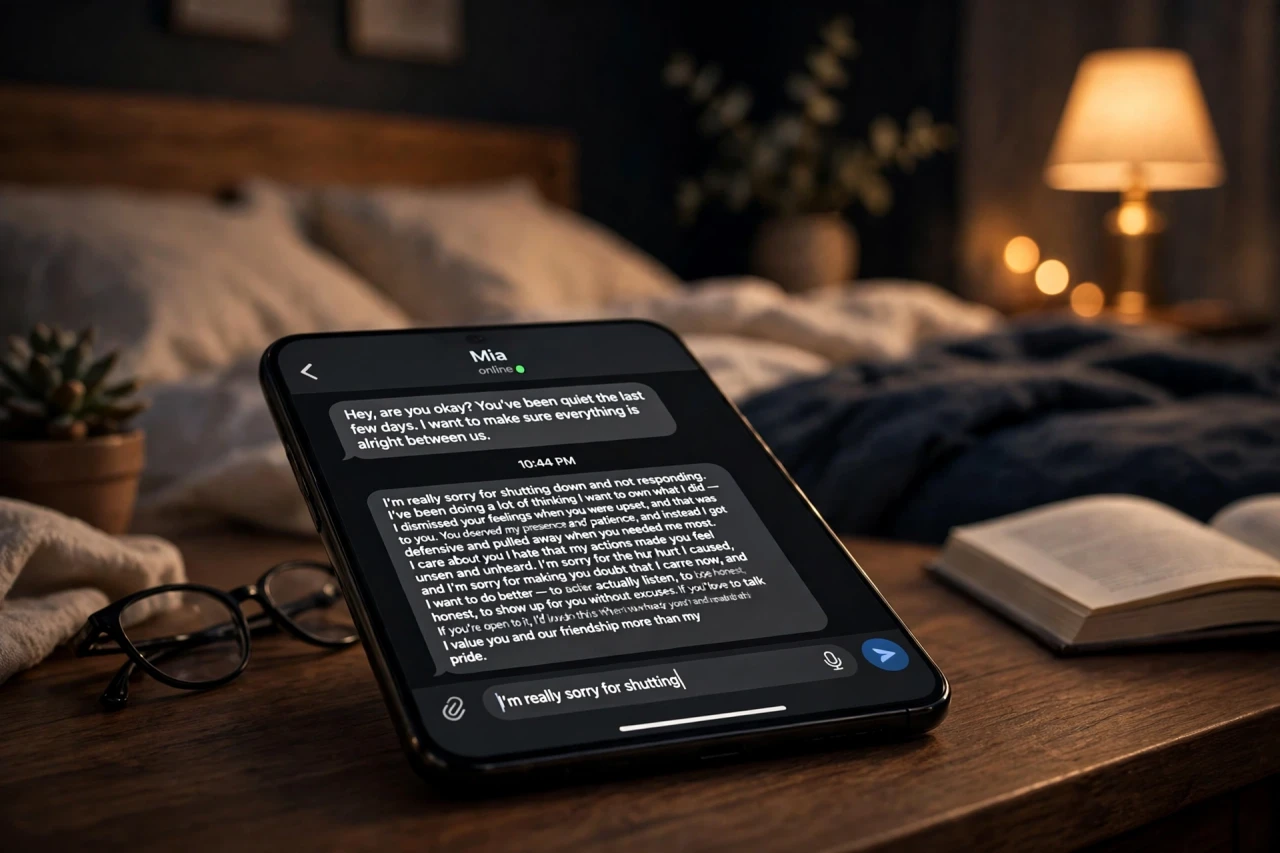
🤫 How to Apologize to Your Boyfriend Sincerely When He Will Not Talk to You
Sometimes you are ready to apologize and he is not ready to hear it. He is not answering, or he answers in single syllables, or he has explicitly said he needs space. This is one of the hardest positions to be in, because every instinct screams at you to fix it now. Resisting that instinct is part of the apology.
First, respect the boundary completely. Space he asked for is not space you get to negotiate. Sending five messages after he said "I need a few days" does not prove love. It proves you cannot tolerate his boundaries, which is likely related to whatever you are apologizing for. One sincere message, then genuine silence.
Second, use the waiting time productively instead of anxiously. Write the full apology out. Get clear on the five ingredients. Think honestly about what needs to change and whether you are actually willing to change it. The waiting period is not dead time. It is preparation time, and a prepared apology is ten times more convincing than a panicked one.
Third, watch for the difference between needing space and stonewalling. A few days of quiet to process is healthy. Two weeks of total silence with no timeline is not processing, it is punishment or avoidance. If the silence stretches past a week with no word, one calm check-in is fair: "I respect your space. I want you to know I am ready to talk whenever you are." Then step back again.
There is also a harder possibility to consider. If he consistently refuses to engage with any repair attempt, no matter how sincere, you may be looking at signs of emotional immaturity in how he handles conflict. A partner who will not participate in repair at all is telling you something important about the relationship's future. One sincere apology deserves a hearing. It does not deserve to be held hostage forever.

🌱 After You Apologize to Your Boyfriend Sincerely: The 14-Day Repair Plan
The apology is day one. Days two through fourteen are where trust is actually rebuilt, and most couples have no plan for them. They apologize, feel relieved, and slide back into the exact dynamic that caused the problem. This fourteen-day plan prevents that slide. It turns your apology into a visible, trackable change.
Days 1 to 3: Stabilize
Your only job is consistency and calm. Keep your routines. Do not overcompensate with frantic affection, which reads as guilt, not love. If he brings the incident up again, listen fully without defending. Repeat conversations are not a sign your apology failed. They are a sign he is still processing, and processing takes the time it takes. This is also the week to start the small daily habit that proves your reform promise, whether that is the twenty-minute cool-down rule or the calendar system for promises.
Days 4 to 7: Reconnect
Now actively rebuild the warmth. Plan one genuine date, not a grand gesture, just protected time together doing something you both enjoy. Physical affection matters here: the small touches, the longer hug, sitting close on the couch. These are the body's way of saying we are safe again. This is also a good week to introduce weekly relationship check-in questions, a simple ritual where you each share one thing that felt good and one thing that felt off. Couples who check in regularly catch small hurts before they become big ones.
Days 8 to 14: Prove the pattern
This is where most repair efforts quietly die, because the emotional urgency has faded. Your job in week two is to keep the change visible when nobody is watching for it. Keep the promise system. Keep naming your bad headspace before it leaks. Notice the moments where the old pattern almost resurfaced and you chose differently, and mention one of them to him casually: "I almost snapped about the dishes just now, caught myself." That sentence is worth a hundred apologies. It proves the reform is real, not performed. By day fourteen, you are not done, but you have built something he can stand on. That is what learning how to reconnect with him emotionally after the dust settles really looks like in practice: not one perfect conversation, but two steady weeks.
One final note on the repair plan. If during these two weeks you notice the same fight recurring in the same shape, the issue may be bigger than one apology can fix. Recurring fights about the same core wound sometimes need a couples counselor, and suggesting that is not an admission of failure. It is the most sincere repair move of all.

❓ Frequently Asked Questions About How to Apologize to Your Boyfriend Sincerely
How long should I wait before I apologize to my boyfriend sincerely?
For most conflicts, between a few hours and one full day. That window lets the emotional flooding pass while the hurt is still fresh enough to address. If he is in acute distress, offer a short holding apology immediately and save the full conversation for later. Never let "waiting for the right moment" stretch past three days, because at that point waiting has become avoidance.
What if I apologized sincerely and he still will not forgive me?
First, give it time. Genuine forgiveness often lags behind a good apology by days or weeks, especially for deeper wounds. Second, check whether your behavior change is visible to him, because words without changed behavior feel empty over time. Third, have one honest conversation where you ask what he needs that he has not received yet. If he cannot name anything and simply refuses all repair indefinitely, that is information about him, not a verdict on your apology.
Should I apologize to my boyfriend sincerely over text or in person?
In person is better for anything serious, because tone and body language carry the remorse that text flattens. Text works when he has asked for space, when distance separates you, or when a face-to-face talk is days away. The rule is simple: use text to deliver a sincere holding apology and request a real conversation, not to resolve the whole thing in a chat thread.
How do I apologize without sounding like I am making excuses?
Separate the apology from the explanation completely. Deliver the full apology first: what you did, why it was wrong, and what will change, with zero reasons attached. If context genuinely matters, raise it days later in a calm moment, framed as understanding rather than defense: "I have been thinking about why I reacted that way." Reasons offered inside an apology always sound like excuses. Reasons offered later sound like growth.
What is the difference between apologizing and groveling?
An apology restores his dignity. Groveling surrenders yours. The line is crossed when you start begging, making promises you cannot keep, accepting blame for things you did not do, or apologizing repeatedly to purchase reassurance. A sincere apology is dignified: clear, complete, and delivered once. If you feel the urge to grovel, that is usually guilt talking, and guilt is about soothing you, not healing him.
How many times should I apologize for the same mistake?
Fully, once. After a complete sincere apology, further apologies should be replaced by changed behavior. If he brings it up again, listen and validate rather than re-apologizing on a loop. The exception is if you discover a new dimension of the hurt you had not acknowledged, which deserves its own acknowledgment. But apologizing for the same thing weekly means the pattern has not changed, and that is the real problem to solve.
Can a sincere apology fix cheating?
It can begin the repair, but it cannot complete it alone. Betrayals of that size need months of consistent changed behavior, radical transparency, and often professional help. A sincere apology matters enormously as the starting point, because it proves you grasp the full weight of what you did. But trust after infidelity is rebuilt in hundreds of small verifiable moments, not one conversation. Be honest with yourself about whether you are prepared for that long road before you ask him to walk it with you.
What if he uses my apology against me in later fights?
That is a serious red flag about how conflict works in your relationship. A sincere apology is a gift, not ammunition, and a partner who stockpiles your apologies to deploy them later is punishing your honesty. Name it directly and calmly: "When I apologized, I trusted you with that. Using it against me makes it harder for me to be honest next time." If the pattern continues, you are looking at warning signs that go beyond a rough patch, and it is worth reading about them with clear eyes. Healthy repair requires both people to protect the vulnerability the other offers.
💖 Summary: How to Apologize to Your Boyfriend Sincerely and Mean It
Learning how to apologize to your boyfriend sincerely comes down to five things: name exactly what you did, own it without footnotes, let him feel your remorse, offer a real repair, and prove the change over the following weeks. Time it after the flooding passes but before distance hardens. Keep it private, deliver it once, and never follow it with a demand for instant forgiveness.
Use the scripts in this guide as starting points, not teleprompters, and pair your words with one thoughtful gesture that proves you were thinking of him. Then work the fourteen-day repair plan: stabilize, reconnect, and prove the pattern. If you do all of that, you will not just survive the fight. You will come out of it with a relationship that handles conflict better than before, which is the quiet superpower of the green flags of a healthy partnership: repair, honesty, and the courage to grow.